Hi,
I’m in New Zealand at the moment and not available for repair, mods, etc…..
I’ll let you know when I’m back, probably end of 2012…
In the meantime just try it here:
Schraub und Dreh
Thanks
Tobi


Hi,
I’m in New Zealand at the moment and not available for repair, mods, etc…..
I’ll let you know when I’m back, probably end of 2012…
In the meantime just try it here:
Schraub und Dreh
Thanks
Tobi
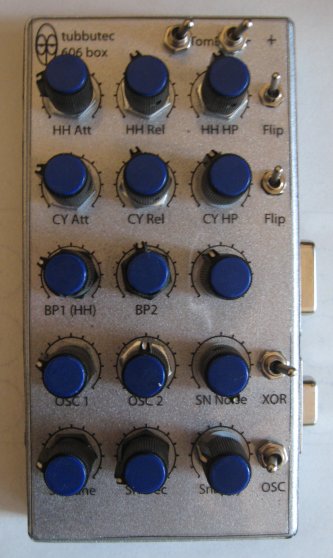
My new 606 mod. I included some features that I think are new to the world.
Cymbal and open hihat got an attack/decay envelope which is fully sensitive to velocity. This gives you independent control over the attack and decay times and the volume of the instrument.
Also I added a ring mod variant to the existing six hihat/cymbal oscillators using XORs. Gives you a great range of metallic sounds.
Audio soon to come…
Features:
-Open Hihat attack, decay [velocity sensitive!!]
-Cymbal attack, decay [velocity sensitive!!]
-Control pitch of two oscillators for the cymbal and hihat metal sound
-Chose hihat sound to be, oscillators, two oscillators with ringmod, four oscillators with ringmod, mix
-Adjust hihat highpass
-Adjust cymbal highpass
-Adjust hihat+cymbal bandpass
-Adjust cymbal bandpass
-Low tom pitch
-Switch tom noise
-Snare noise amount
-Snare tune
-Snare decay
-Snare highpass filter

Features:
-Midi-In (controls pitch, vca att., vcf att, filter, pw)
-Adjust VCF and VCA attack independently
-Extended LFO Range (100Hz to 0.1Hz)
-Filter moulation (chose between 15 different modes and sources)
-Distortion
-Ext. audio in
-Triangle waveform
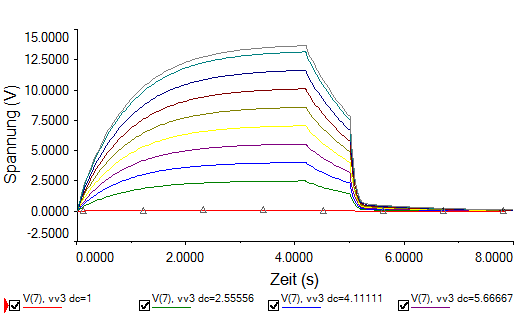
Have been working on a velocity sensitive AR-envelope for TR-606 and TR-808. Attack and Release times can be adjusted between 1ms and 5s and of course the open hihat can be cut by the closed hihat.
Simulation results look very promising:


just a random collection of tubbutec in the news:
http://www.sequencer.de/blog/?p=9296
http://matrixsynth.blogspot.com/2011/01/polysix-mod-by-tubbutec.html
http://matrixsynth.blogspot.com/2011/01/tubbutec-mods-and-synth-repair.html
Polysix mod by Tubbutec from Tubbutec on Vimeo.
More info coming soon!
I just put insert jacks on my ‘things to check first’ – list. A couple of days ago I repaired a Soundcraft mixer, after disassembling it and figuring out the signal path (didn’t have schematics) it turned out that the contacts on the insert jacks were corroded disabling the signal flow.
The very same problem just occurred in an audio amplifier whose headphone jacket had the same problem leading to a defect left channel.

The Korg Polysix is a great Synthesizer and well known for its beautiful strings and pads and for its fat basslines (just to name a few possibilities). The effect unit features three independent delay lines which are modulated by a special kind of LFO with three sines 120° apart from each other. The “ensemble” setting makes use of this possibility and creates a unique dense sound which you won’t find in any other comparable synthesizer.
It’s also possible to modify the Polysix a future article will probably cover the possibilities here.
Unfortunately more and more Polysix units end up broken, because the battery needed to keep the internal memory tends to leak when it get old. The battery acid destroys traces on the PCB, ICs and sometimes even the processor. It often takes a long while to replace the broken parts and restore the broken traces.I already repaired three Polysix’s with this problem and one of these was actually a total loss, because repairing would have cost more than the price of a new Polysix (that was a few years ago when a P6 was about 200€). (btw. I repaired it nevertheless, I just love these synths^^)
so please: If your Polysix still has the original battery please change it or get it changed!!
It is a standard procedure and costs about 30€,…or you just do it yourself. Old Crow has a detailed how to.
It is a real shame with every Polysix that is broken beyond repair.

The picture shows some fixed traces in a Polysix, luckily this unit was not destroyed badly and it was possible to fix it quite fast.

