Rhythm Ace FR2 uniPulse install

This manual describes how to install uniPulse in the Rhythm Ace FR2L

This is based on the schematics and has not been tested yet. Please let us know if you have installed it. Bonus points if you send us a video of the drum machine in action 🙂
Download the uniPulse Configurator file for Rhythm Ace FR2L

uniPulse power

In order to power the uniPulse, you need to install a few additonal components. Due to the high voltage after the transformer, an additional 15V regulator must be used (7815). The capacitors should have a voltage rating of at least 35V, more is ok. Connect the uniPulse V+ and V- wires as shown in the picture.

Trigger

Trigger are very straight forward. Most triggers are soldered to the legs of diodes on the voice boards. Cymbal and Maracas triggers are simply connected to the solder points on the voice boards. It is also possible to control the Brush (B), but without testing it is hard to tell exactly how. This will be updated as soon as this information is available.

Clock sync

As always syncing the drum machine to the midi clock is optional and requires additional circuitry.
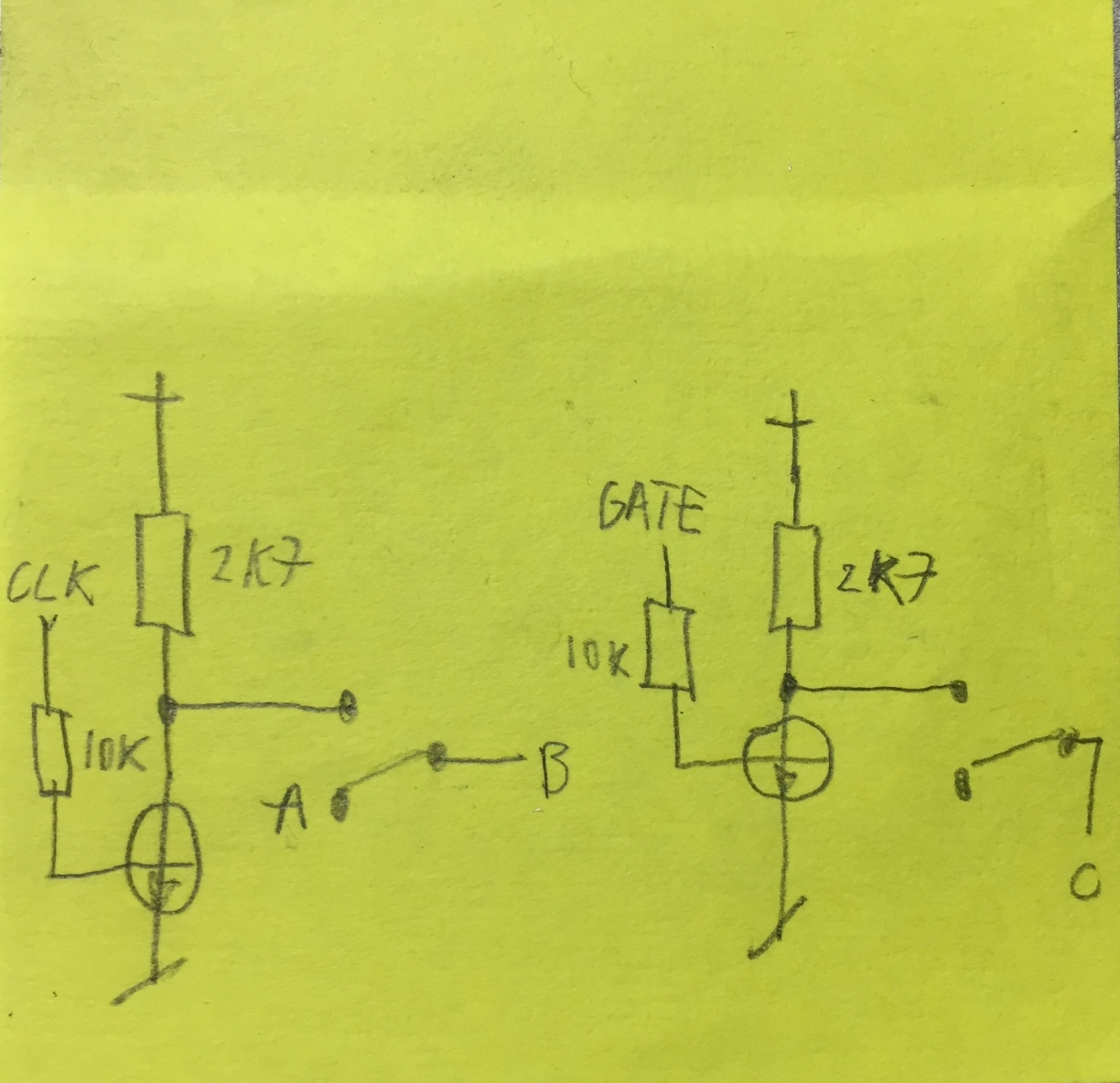
A level shifter is needed for the start/stop signal. Two pole switch (included in the kit) is used to switch between internal clock and midi clock. In order to access points A and B, desolder one leg of R12. A is connected to the resistor, B is connected to the board where the resistor was connected originally.
Point C can be directly connected to the Start/Stop switch.

ELKA Drummer One uniPulse installation

This manual shows how to install uniPulse in the ELKA Drummer One and thus allows to trigger voices via midi and to sync the Drummer One to midi Clock.

Thank you very much to Thomas Kayser of SynthMedic for figuring this out and providing pictures.

After installation use the Config Tool to upload the Config file for ELKA Drummer One (right click, save as).

Connecting trigger points

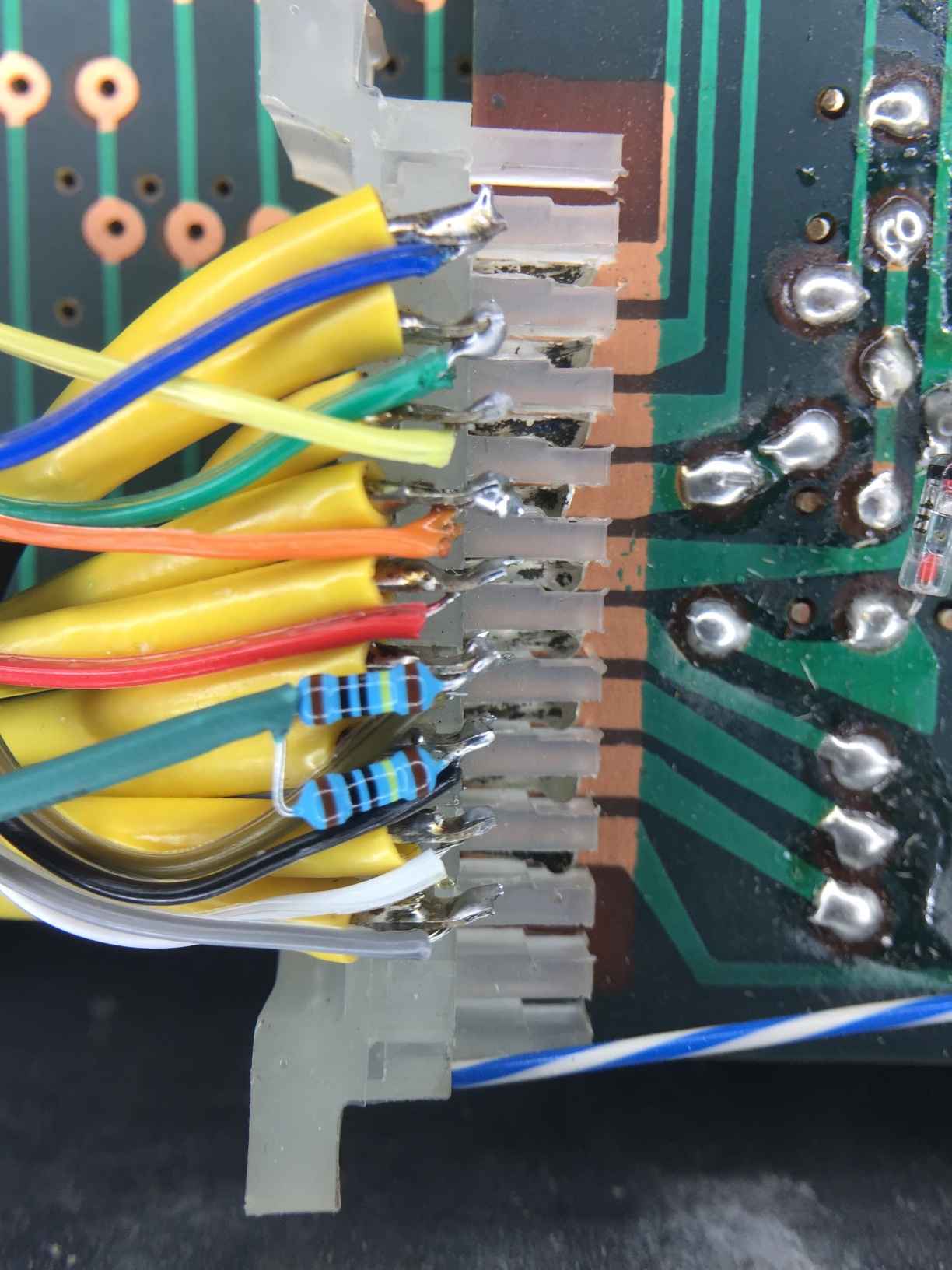
Below you can see the installed uniPulse. Trigger points are on the right the picture below shows the trigger points in a bit more detail. Two of the triggers needed additional 1Meg resistors to ground which can also be seen in the picture. UniPulse channels 1-9 are used.

Midi Clock Sync

If you like, you can also sync the Drummer One to midi clock. This requires a bit of additional circuitry. A two-pole switch is used to switch between internal and midi clock. This switch is provided with the uniPulse kit since uniPulse MK2. You will also need two general purpose NPN Transistors and 2x10k and 2×2.7k resistors. The circuit can be seen below. Its purpose is to level shift the clock and gate voltages.

The GATE signal is connected to uniPulse pin D1, the CLOCK signal to uniPulse pin D2.
The picture below shows the location of the C point and the circuit on a prefboard. To access points A and B, one leg of a capacitor needs to be desoldered. This is also shown in the picture below and in more detail in the next picture.

Installing the uniPulse board

You can mount the uniPulse board in the case using distancers as shown here:

The Drummer One needs to be in start mode with all Rhythms deselected in order to be synced to midi.

Roland TR-66 unipulse Installation

A customer sent us the uniPulse trigger points for the Roland TR-66. Thank you very much! Installing is very simple, just connect the unipulse to the trigger points as shown and upload the config file via the tool.

As you can see there are 9 instruments you can trigger:

BD = Bassdrum
SD = Snare Drum
HH = Hihat
CY = Cymbal
HC = High Conga
LB = Low Bongo
HB = High Bongo
C = Conga
RS = Rim Shot / Cow Bell

Just connect uniPulse outputs P1 .. P9 to these points, configure these outputs using the configurator as ’15V, negative, Open Rect’ and you are good to go.

When the bossanova rhythm is selected, you will hear the Rim Shot. If no rhythm is selected, the cowbell will sound.

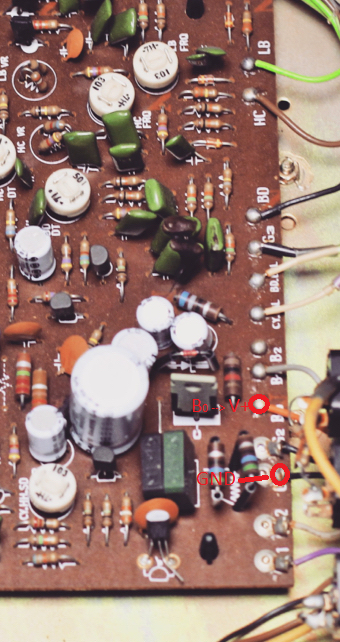
uniPulse needs some Power and you can get it by connecting uniPulse GND to G1 or G2, and connect uniPulse V+ to B0 of the voice board as shown in the next picture.

Have fun!

Boss DR110 uniPulse install

This manual describes how to install uniPulse in a Boss DR-110. If gives you velocity sensitive trigger of the instruments, accent trigger and midi clock sync.

There are two additional sounds that can be triggered via midi: Part of the clap (electric snare) and part of the cymbal.

For the DR-110 you need to get the custom DR-110 uniPulse version.

Installing the kit does not require to cut any traces and is generally a simple soldering job. You do however need to drill a hole for the MIDI socket. We use a 3.5mm jack socket and include an adapter. If you require, you can also install a DIN-socket, but it only barely fits. You also need to install 2 additional switches: One switch to select the clock source (MIDI or internal). The other to switch the bassdrum trigger from MIDI to internal.

MIDI is received on channel 10 with the following notes:

Note

Name

35

Bass Drum

38

Snare

39

Clap

40

Electric Snare (extra sound)

42

Closed Hihat

46

Open Hihat

49

Cymbal

51

Extra Cymbal

33

Accent on/off

Installation manual as PDF

Korg MiniPops 120 uniPulse installation

Here is how to add velocity sensitive midi input to a Korg Minipops 120 using the uniPulse.

Check Minipops-120 Single Outputs for information on how to add single outputs.

MiniPops 120P – the portable version of the MiniPops 120

There is a portable version of the MiniPops 120. While electronically identical to the normal version there are mechanical differences. Hence you`ll find details on how to install Unipulse in this PDF:

Unipulse installation in Korg MiniPops 120P

Continue reading

CR-5000 / CR-8000 trigger points for uniPulse

This is how to install the uniPulse in a CR-5000 or CR-8000.


Update: User ‘a.d.a.m.baby’ on MuffWiggler found some great additions to this manual.

Here are the schematics and pictures with trigger points. Points in blue must be triggered with a negative voltage, points in red with a positive one. You can connect the uniPulse trigger outputs directly to these points. Use the configuration program to program the behaviour and polarity of the trigger outputs. Trigger points can be found on the bottom of this post.

Here is the schematic with the trigger points.

On the next picture you will see the whole CR-8000 voiceboard with the cables connected to each trigger point. Open the picture (download it) and zoom in to see where exactly the trigger points are. P9 is not used, please ignore!
If you want to trigger the Accent, solder the cable from D3 to a 1k Resistor and a Diode (1N4148 or similar; Polarity like shown in the picture) and the other end of the diode to the trigger point. In the config file provided accent is triggered via a midi note. If you prefer accent to be triggered if velocity is at 127, you can configure D3 as ‘Accent’ in the config tool.

They are labeled P1 to P16 corresponding to the uniPulse trigger outputs and colors.


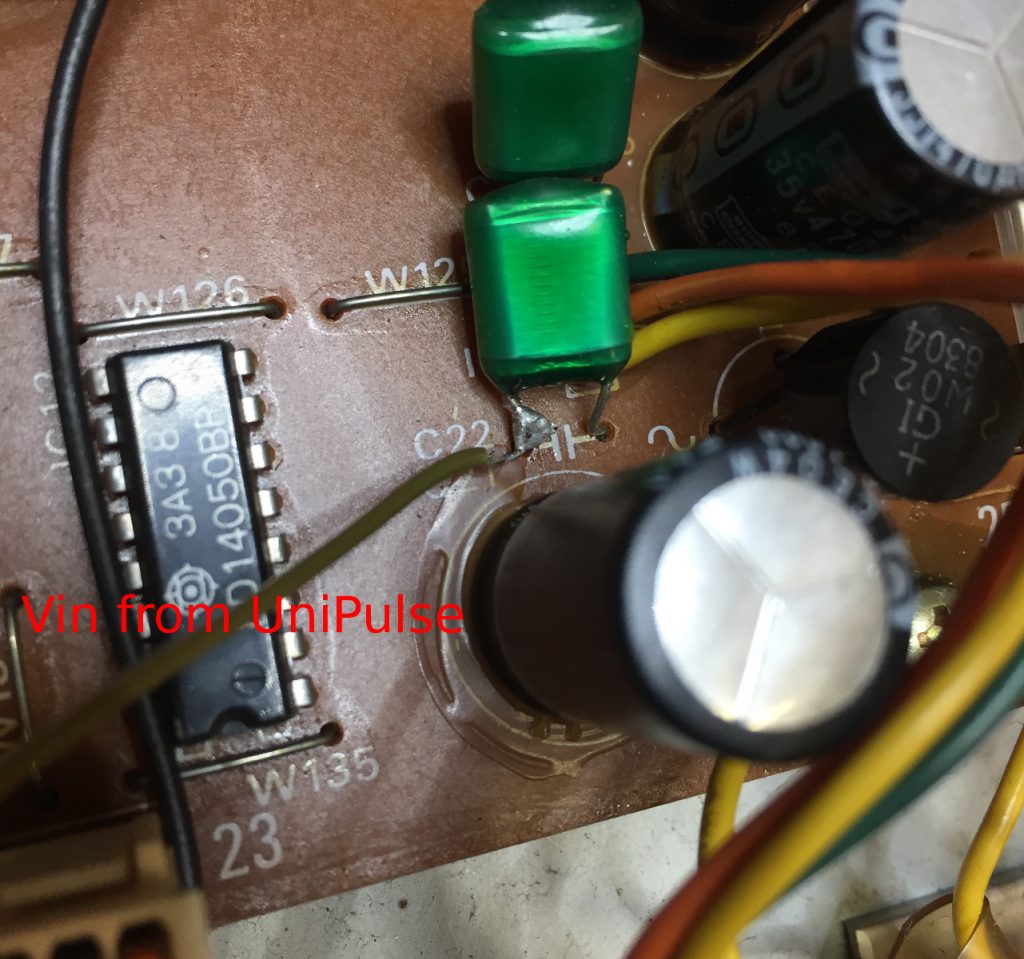
Connect the brown Vin cable from UniPulse to the left leg of C22
 

Midi sync CR-5000

In order to add midi sync to the 5000 you need to cut the two traces coming from IC15 as shown in the schematics below. You then add a two pole switch and connect it to two digital outs of the uniPulse. Configure the outputs as clock and start/stop. You can now use the switch to change between internal and midi clock.

There is another method to install Midi Sync on a CR-5000, as pointed out by a user. We don´t know if this is true for all CR-5000s, but the machine of the user has jumper wires installed which can easily be desoldered and the switch can be installed in their locations. The solder points closest to the CPU go to the middle pins of the switch.

The user also pointed out that the Sync Gate (the D1 line from Unipulse) needs to be inverted. We don´t have a CR-5000 at hand, so we couldn´t check this. You can just try that if you´re having trouble when using the provided config file. Just invert the signal in the Tubbutec Unipulse Configurator software and upload it to Unipulse.

Midi sync CR-8000

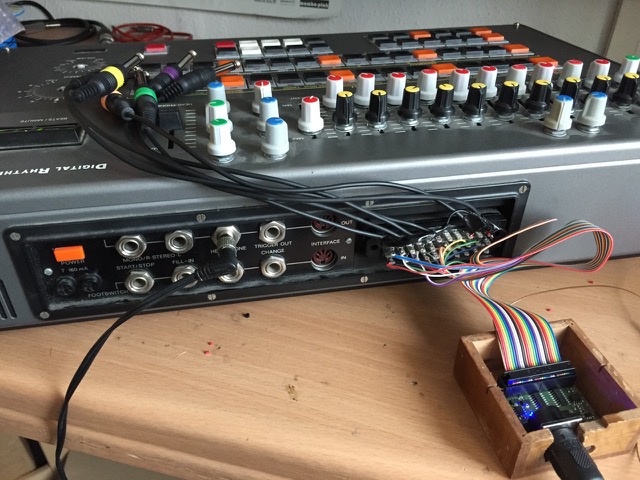
For the CR-8000 sync is very easy to install as it has a din-sync input. Just connect two digital outs of the uniPulse to the DIN-SYNC start and clock lines and configure the outputs with the configuration program.
You don’t even have to drill a hole for the midi socket – you can use the existing dinsync socket without losing its functionality because pins 4 and 5 are not used.

MIDI and DIN Sync

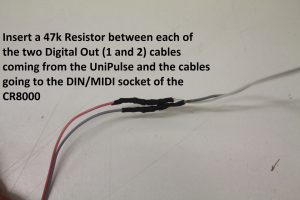
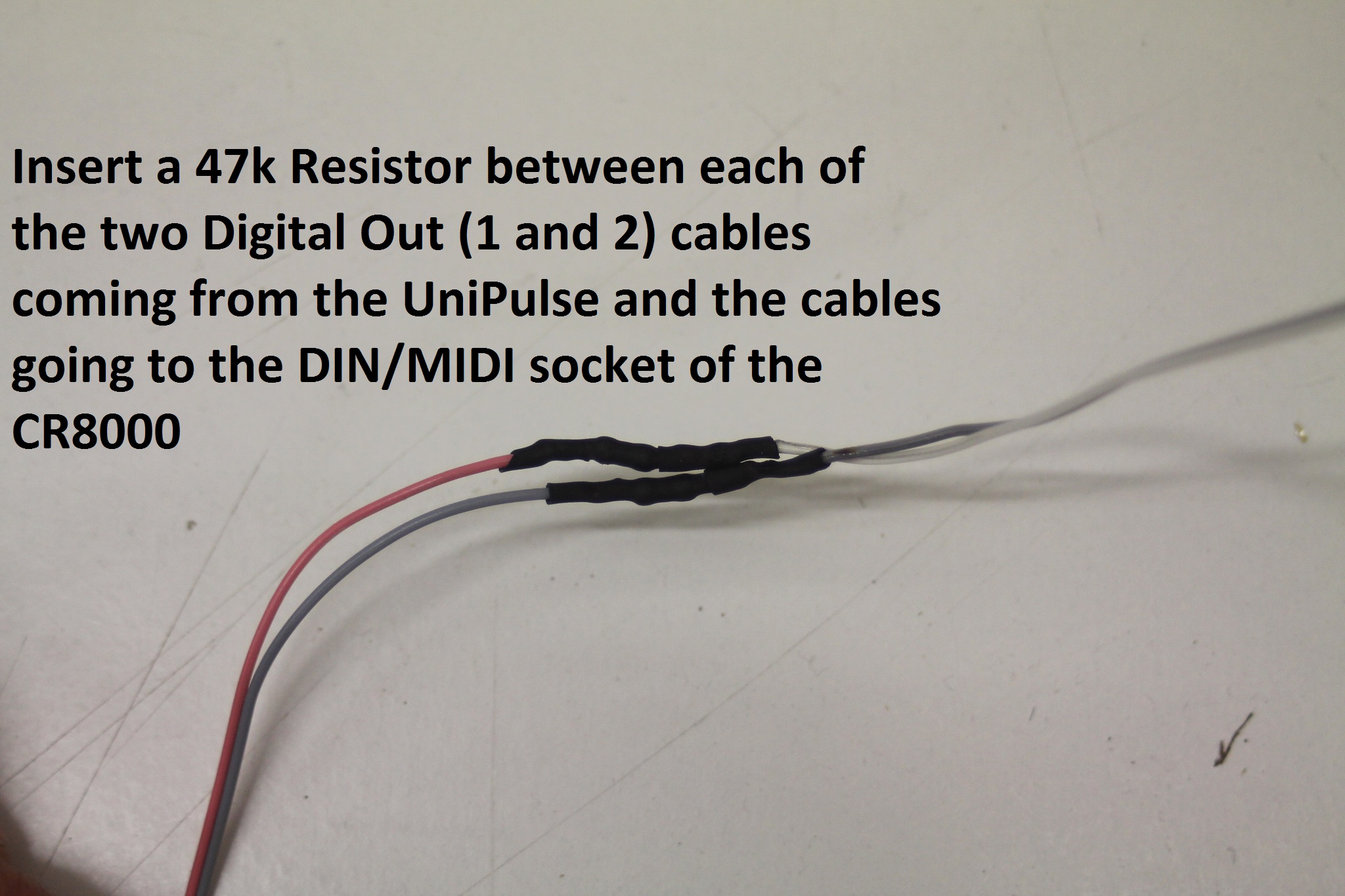
Solder a 47k Resistor between D1 and the cable running to the DIN-Connector, do the same for D2. (if you put the uniPulse to the same position we did, the cables from the uniPulse may not be long enough, thats why the cables have a different color on the DIN-socket) See attached pictures.

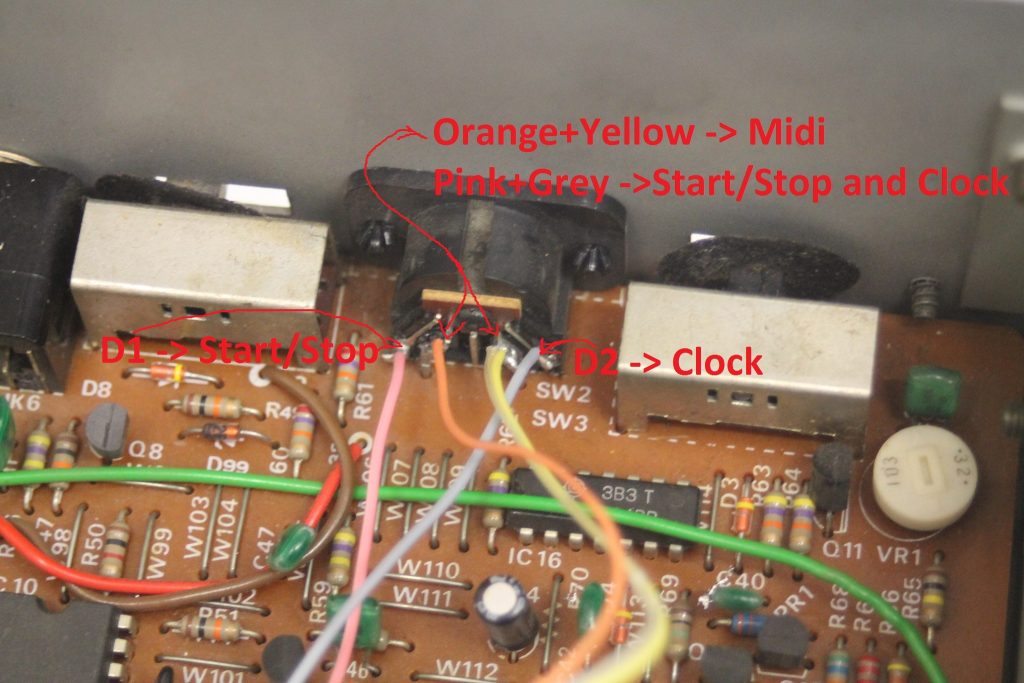
You need to cut the wires from the MIDI-connector provided with uniPulse. Solder the cables the same way they were to the DIN-Connector of the CR-8000. See again the picture above.

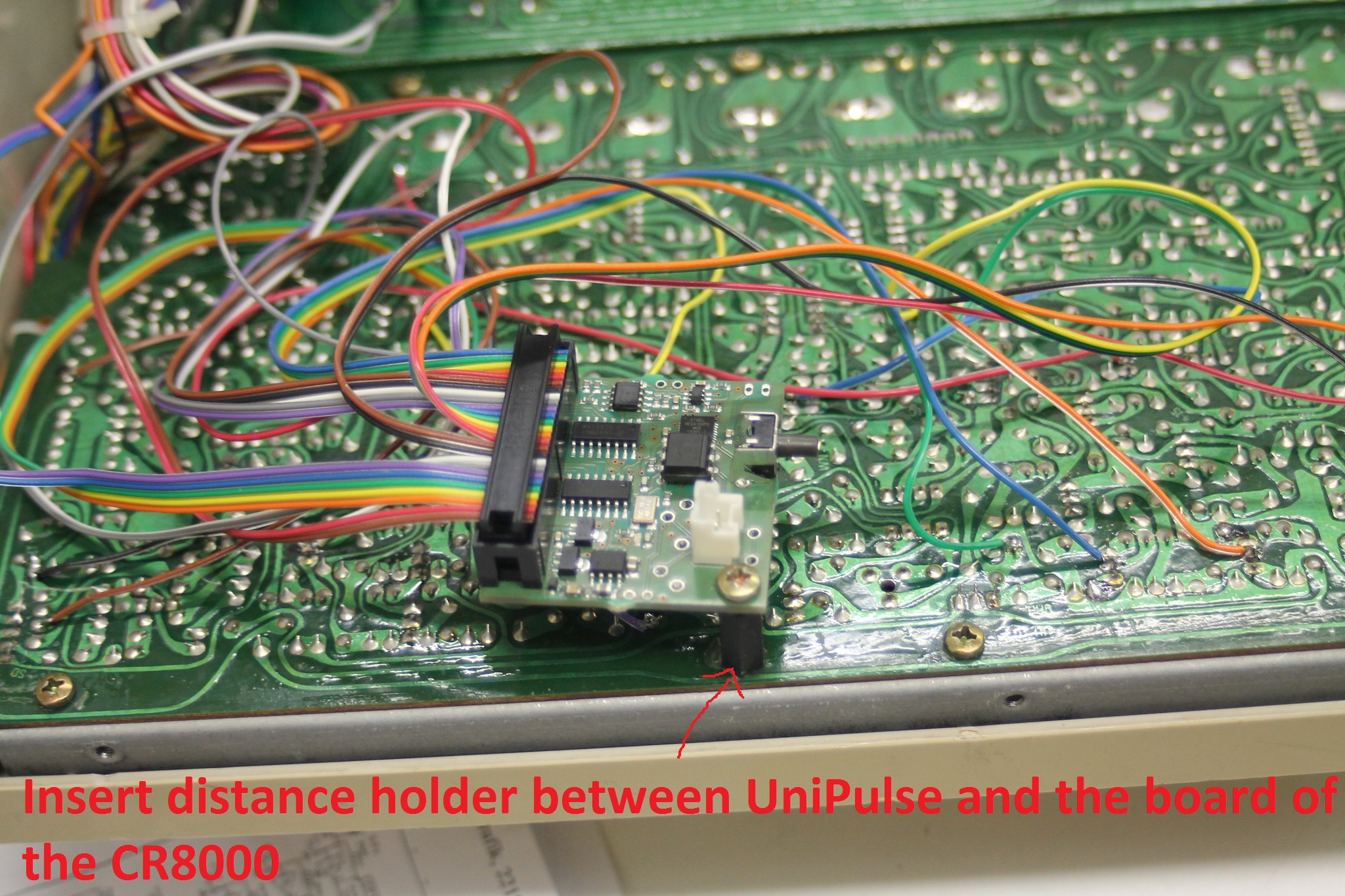
Now you can put the uniPulse in place. Use a distance holder screw. You can also find a different place to put the uniPulse if you like.
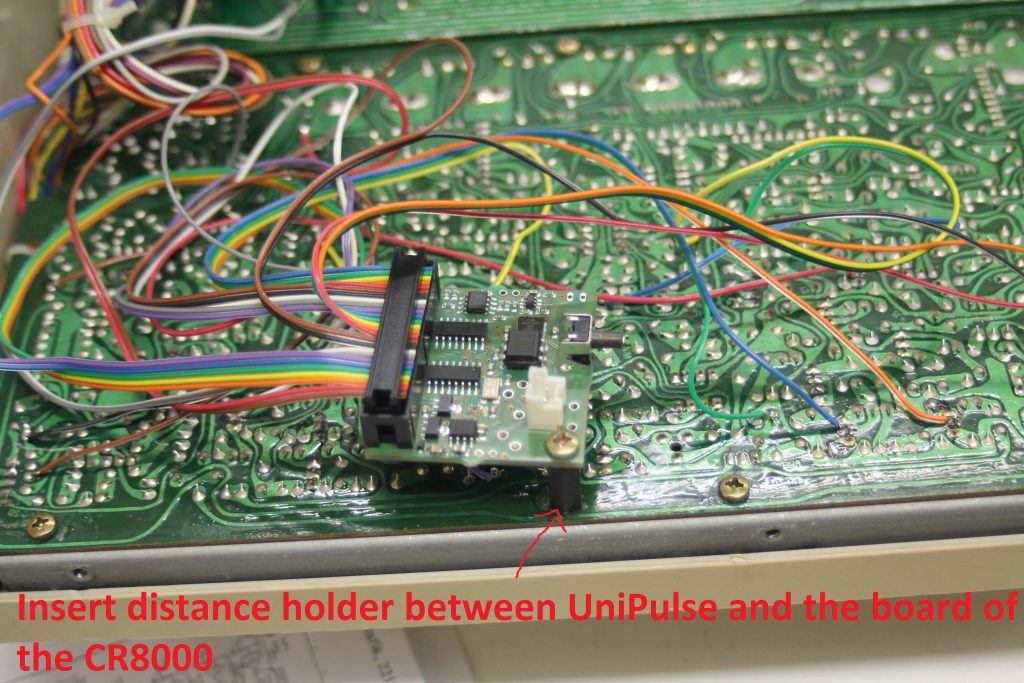
Finally you only need to upload the CR-8000 / CR-5000 config file to the uniPulse and you are ready to rock!

Midi for Korg Minipops 7 (uniPulse installation)

This guide shows you how to use the Tubbutec uniPulse interface with a Korg Minipops 7. You can also add outputs for each instrument.

The config file for the Korg Minipops 7 is here.

Features:

– Full velocity control for all 14 instruments
– Velocity controls guiro pitch
– Midi sync (optional)

Guiro pitch is controlled by midi velocity. If you want a fixed pitch, adjust CV-voltage until the desired pitch is reached.

These are the midi notes to trigger the instruments when using our config file. You can of course change these notes using the uniPulse configurator.

  • Note 64: Conga
  • Note 60: SB
  • Note 61: LB
  • Note 75: CL
  • Note 37: RS
  • Note 36: BD
  • Note 82: QUI
  • Note 54: TAM
  • Note 38: SD1
  • Note 40: SD2
  • Note 42: HH
  • Note 49: CY1
  • Note 51:CY2
  • Note 56: CB
  • Note 74: Guiro, velocity controls pich

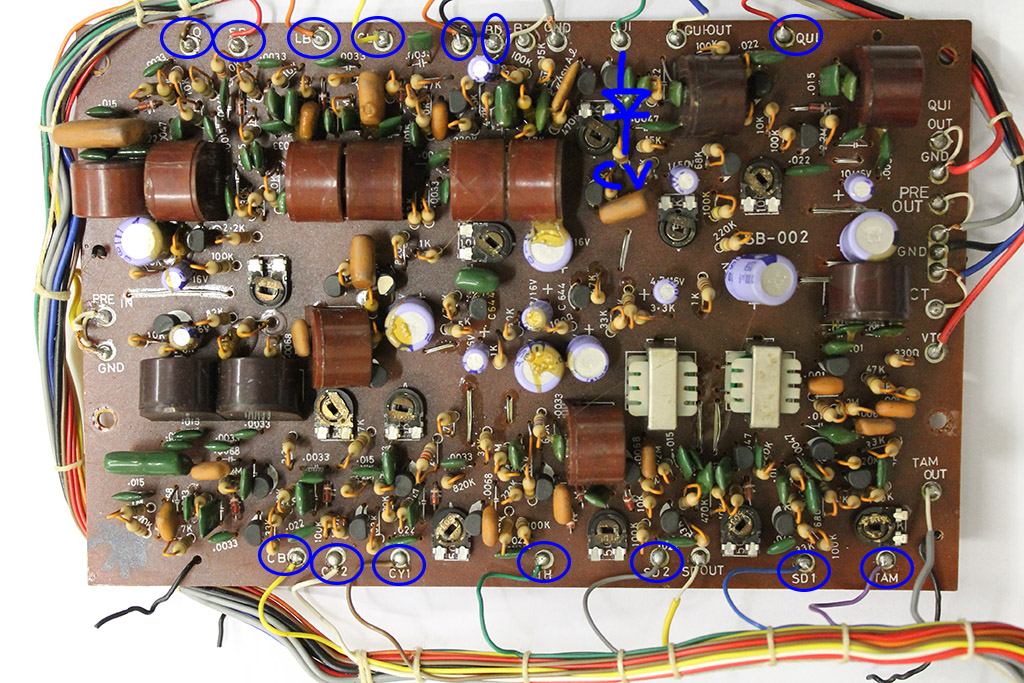
Trigger points:

The image below shows the trigger points. You can solder the uniPulse trigger outs directly to these points. An exception is the Guiro, which is connected to the uniPulse CV-out with an additional diode.

Continue reading