Happy new year from Tubbutec !
Coming up 2015:
- Major firmware update for the Modsix with new exciting features (January)
- ModyPoly – Modysix for Korg Mono/Poly (January)
- RGH Dynamizer (February)
- A new project we are working on ^^
- Probably much more..


Happy new year from Tubbutec !
Coming up 2015:
In addition to the filter CV out, the newer Modysix models feature a second CV output. It can be used for various tasks such as pitch bend, resonance control, pulse width control,…
Please note: In any case additional resistors and some soldering skill is needed to interface the CV out to your Synthesizer.This is not an official feature of the Modysix, but rather a little bonus to the already vast set of features, so please do not expect the same amount of support from Tubbutec. If you found an interesting application and want to share it with other Modysix users, please use the comment section below or send us an email.
Does my Modysix have a second CV out?
Your Modysix has a secon CV out, if there is a red wire alongside the orange filter wire.
The CV out is capable of an output voltage from 0 to 5V with a default voltage of 2.5V at start up. It is actually a PWM modulated signal, which has to be filtered, but this is already done in the Synthesizers circuitry or can easily be added. More about this later.
The CV responds to pitch bend commands and newer models also to controller number 21.
In order to add midi controlled pitch bend to your Polysix you need two resistors, one 68k one 34k. Other values are also possible, as long as one has double the value of the other. This will change the maximum pitch bend range. Smaller values will increase the range.

Depending on resistor tolerances and actual value of the -5V rail, the overall pitch might change a little, when installing this. You can correct this with pitch bend calibration in the Modysix config menu (see Modysix manual).

Soldered resistors in a Polysix to get midi controlled pitch bend and the red pitch bend wire.
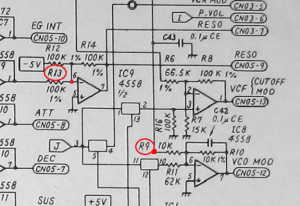
fig 2
Figure 2 shows part of the Polysix schematic including the pitch bend (R9) and resonance R13 injection points. This is board KLM 367.
Same circuit as for the pitch bend above, but connect it to R13. You might want to add a 100nF capacitor in parallel to R14 to filter the PWM signal. This gives you a bipolar resonance control.
More possible applications of the 2nd CV out will be added soon…
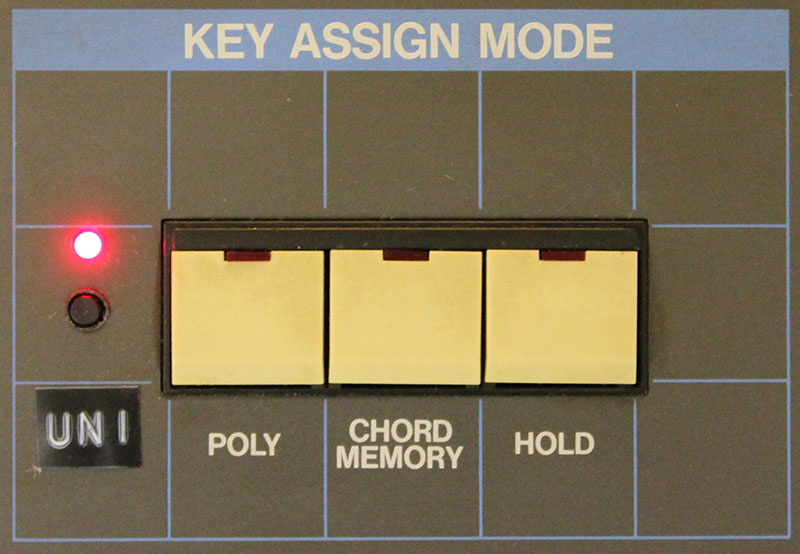
While the older brother of the Korg Poly-61, the Polysix, features a monophonic ‘Unison’ mode, the Poly-61 does not. The reason is most likely the fact, that the Poly-61 is DCO based, making the voice spread technology used in the Polysix Unison mode not possible.
It is however nevertheless desirable to add a monophonic mode to the Poly-61. Playing a monophonic synth is quite a different experience compared to a polyphonic one and if you have extended features such as not retriggering the envelope when playing legato, a whole new world of sound opens up.
If you install the Modysix mod you will have this feature build in, the only problem is: There is no ‘Unison’ button. You can select the unison mode using Midi, but it is actually quite simple to install an extra button and led.
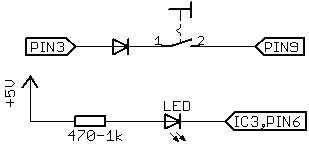
You only need four parts and a little bit of wire: A push button, an led, a diode and a resistor. The push button can be any kind of button, the one I chose is what I had lying around, but you can probably find one that looks more like the original buttons. The diode is a general purpose one, such as 1N4148. For the resistor choose a value of your liking. I found that the value of 470 Ohms used for the other leds in the Poly-61 gives too much brightness with modern leds (led technology has vastly improved in the last 30 years), so you might use a larger value such as 1k Ohms.
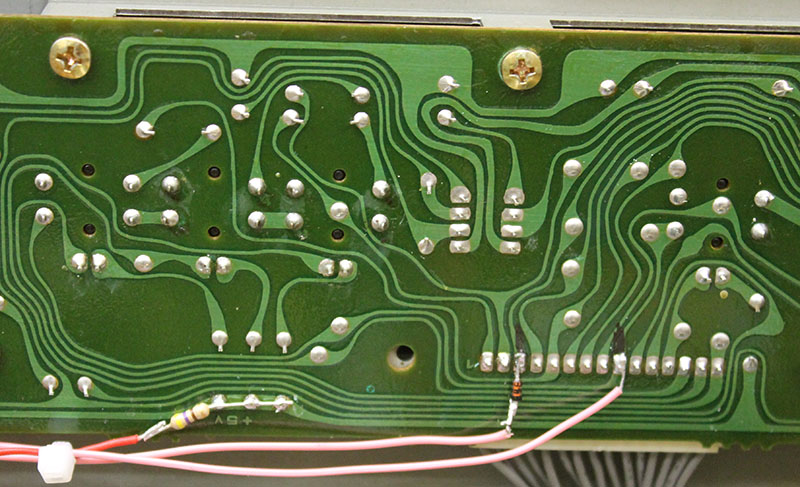
After installing the switch and led in the front panel, you can connect them to the panel board labelled KLM-482 – it is the one the ‘poly’,’chord’,.. buttons are mounted on. Pin3 and Pin9 in the schematic above refers to the pins on the connector on that panel. You can find +5V where I connected the resistor in the picture above. As you can see, I soldered the diode and resistor directly on the back of the PCB.
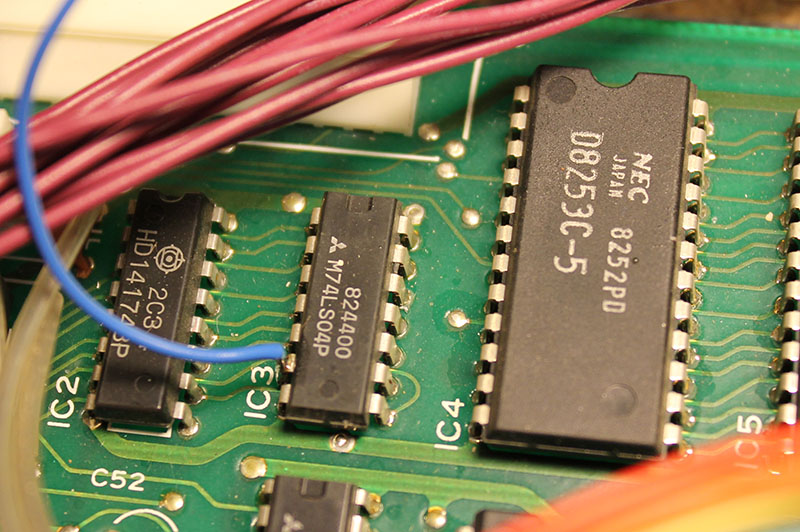
The last connection goes from the LED to Pin6 of IC3. It can be found on the processor board (the one with the battery).
When finished you can now use the unison mode on your Poly-61. Have fun!
The current issue of SynthMag features an article about the Tubbutec Polysex and Modysix mods for the Korg Polysix.
I did not have the opportunity to read the article myself yet, but I am sure it is a fun to read but honest review. So if you need a second opinion maybe this is the place to look.
You can get the magazine in a Kiosk or at their shop (also as PDF).

A beautiful example of a Polysix modded with the Tubbutec Polysex mod:
http://polysix.info/

The author of this blog not only had a walnut chasis manufactured for his Polysix but also created a completly new overlay for the front panel which includes the Polysex mod.
I am sure Imploded View will have some new tracks soon and we will be able to listen to his Polysix 🙂
Here is a video showing a custom midi interface developed by Tubbutec for analogue drum machines such as Korg Minipops, AceTone RythmAce, Maestro Rhythm King MRK-2, Roland TR77,…
It has the following features:
We are happy to announce the release of our second product:
The Tubbutec Modysix – Midi retrofit and feature extension for Korg Polysix and Poly-61

A video showing how I manufacture the new Modysix – Polysix midi retrofit and feature extension
A little video showing only some of the possibilities with the Tubbutec Polysex mod for the Korg Polysix synthesizer.